

In partnership with

Hello! 👋
It's Thursday, 20th August 2026. Hello and welcome back to Bold Efforts! We spend a lot of time asking what happens when AI becomes more intelligent.
I think the more interesting question is what happens when intelligence becomes cheap.
For most of history, getting good thinking done has been expensive. Researching something properly, analyzing a market, writing software, designing a product, reviewing a contract, or planning a strategy meant paying for someone’s time.
That constraint shaped entire industries. A consultant could only take on so many projects. A lawyer could only review so many contracts. A recruiter could only talk to so many candidatess. An engineer could only write so much code.
AI is beginning to change the economics of that work. But abundance doesn't make value disappear. It usually pushes value somewhere else.
We have seen this before
The internet made information abundant.
Before it, finding the right piece of information could require a library, an expert, or days of research. Today, more information than any person could consume in a lifetime is available almost instantly.
That did not make the information economy disappear. It created new bottlenecks.
Once information became abundant, finding the right information became valuable. Google is an obvious example: it didn't sell information. It helped people find it. As publishing became easier, attention became scarce. Social networks and creators built businesses around distribution. As anyone could publish anything, reputation and trust became more important.
The scarce thing changed. AI could do something similar, but on a different layer. Information is already abundant. What is becoming abundant now is the ability to do something with it.
AI can analyze information, turn it into a plan, write a first version, generate alternatives, produce software, and make recommendations.
If the cost of producing competent intellectual work keeps falling, we will have far more of it than we know what to do with. So what becomes scarce instead?
Attention probably gets even more expensive
You can already see an early version of this happening.
It has never been easier to produce a reasonable article, video, website, sales email, presentation, or product. As production gets cheaper, more gets produced.
But there are still only 24 hours in a day.
The result is weird. Making something is getting easier at the same time as getting anyone to care about it is getting harder.
This is true for companies as well as individuals. Building software may become dramatically cheaper, but reaching customers does not automatically become cheaper with it. Generating 100 marketing campaigns is useful only if someone actually wants to see one of them.
AI can increase the supply of content almost without limit. It cannot increase the supply of human attention in the same way.
That makes distribution, brands, communities, and trusted relationships more important, not less.
Judgment becomes more important when answers are cheap
Imagine asking an AI to come up with ten strategies for entering a new market. The hard part used to be producing the analysis. Soon, generating ten plausible strategies might take a few minutes. The harder question will be knowing which one is actually worth pursuing.
The same thing happens in design. Generating 100 directions gets easier. Choosing the one worth pursuing does not.
It happens in hiring. Finding and evaluating more candidates becomes easier. Deciding whom you actually want to bet on still requires judgment.
There is a difference between generating an answer and being responsible for the decision. AI can give you ten plausible strategies. It cannot tell you which one you should bet the company on.
I've noticed this in my own work. Getting a first draft of something used to be the bottleneck. Now it's often the opposite: I can get five decent versions in minutes, and spend much longer deciding which one is actually worth keeping.
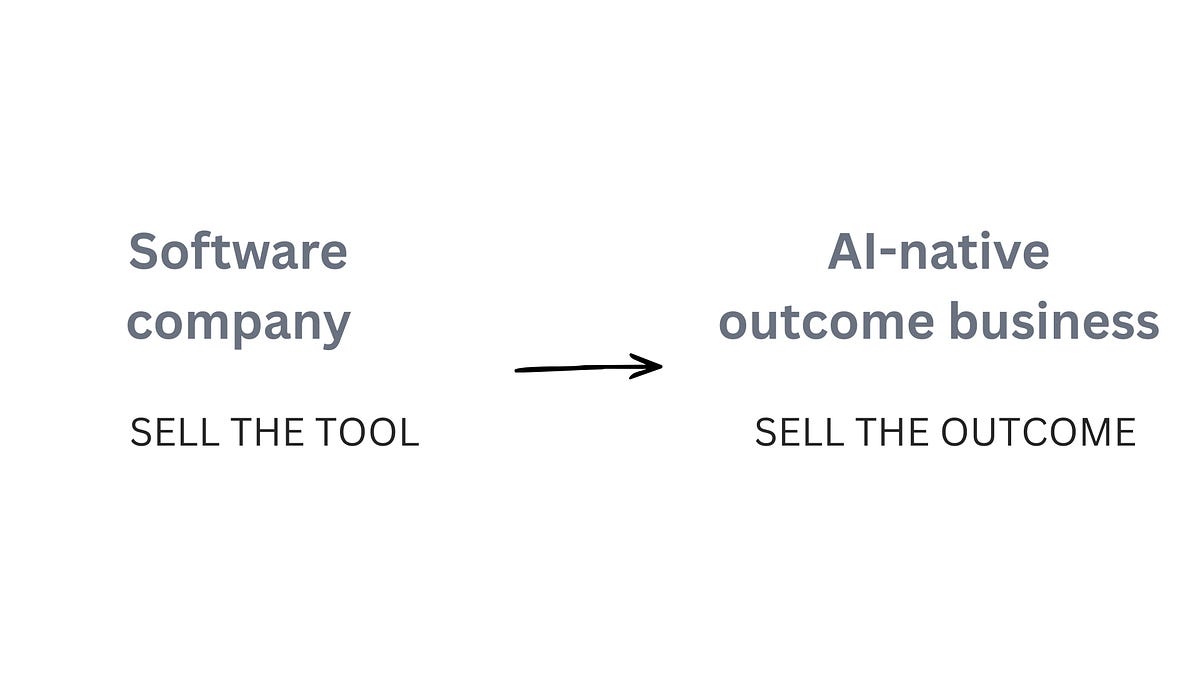
This is why I'm particularly interested in AI-native businesses that sell outcomes rather than software. If the underlying work becomes cheap, the valuable thing may no longer be the tool. It may be the company willing to say: give us the problem, and we’ll own the result.
Trust may be one of the biggest bottlenecks
A world full of AI-generated work will also make competence harder to judge.
A polished report no longer tells you much about how much expertise went into producing it. A beautiful website says less about the quality of the company behind it. A thoughtful email might have taken someone an hour or ten seconds.
When almost anyone can produce something that looks competent, competence itself becomes harder to verify.
So the questions change. Who do you trust? Who has done this before? Who has the right incentives? And, perhaps most importantly, who will take responsibility when something goes wrong?
When convincing output becomes cheap, knowing who produced it and who will stand behind it becomes more valuable.
The irony is that better machines could make certain human qualities more valuable.
And then there is the physical world
There's another constraint that gets overlooked in a lot of AI conversations: the physical world doesn't scale like software.
Cheaper intelligence doesn't create more land. It doesn't create more homes in desirable cities, more nurses, more electricity, or more seats at the best restaurants.
In fact, some of these things could become more valuable precisely because they cannot scale.
If AI makes people wealthier or more productive, that does not mean the cost of everything falls. More money chasing things with fixed or slowly growing supply can push prices in the opposite direction.
We already live in a world where digital abundance exists alongside expensive housing, healthcare, education, and childcare. AI could deepen that split.
We could end up with an odd economy where digital things are incredibly cheap while the physical things people actually want remain expensive.
That is one reason I am skeptical of simple predictions about AI making life universally cheaper. It will make some things dramatically cheaper. Others may become more expensive precisely because they cannot scale in the same way.
What this means for work
Most of the AI jobs debate is still about replacement: how many jobs disappear, and how quickly? That's an important question in the short term. I'm less convinced it's the most useful question over the long term.
Economies reorganize around scarcity.
If routine cognitive production becomes much cheaper, the composition of work will change. Some jobs will disappear, some will shrink, and new categories will emerge around whatever remains scarce.
That is why I don't think the long-term question is simply whether AI creates or destroys jobs. The more interesting question is what kinds of work become valuable when intelligence itself is cheap.

The composition of work changes even when the amount of work does not.
A century ago, many of today's jobs simply didn't exist. Nobody needed a cloud architect or a social media manager. The same will probably be true a hundred years from now, although it's much harder to predict what those jobs will be.
Technology destroyed the economic logic behind some work and created the logic for other work. AI will probably do the same.
What becomes valuable next
It is tempting to look at AI and focus entirely on what it can now produce. Better models. Better code. Better images. Better research. Better answers.
But if these capabilities keep improving, producing intelligence could eventually become almost unremarkable..
The important things will be whatever intelligence cannot make abundant: attention, trust, judgment, relationships, physical space, and time.
The strange thing about technology is that making one thing abundant often makes us notice the things we can't make more of.
Best,
Kartik
I write Bold Efforts every week to think clearly about where work and life are actually headed. If you want these essays in your inbox, you can subscribe here.